Accreditation
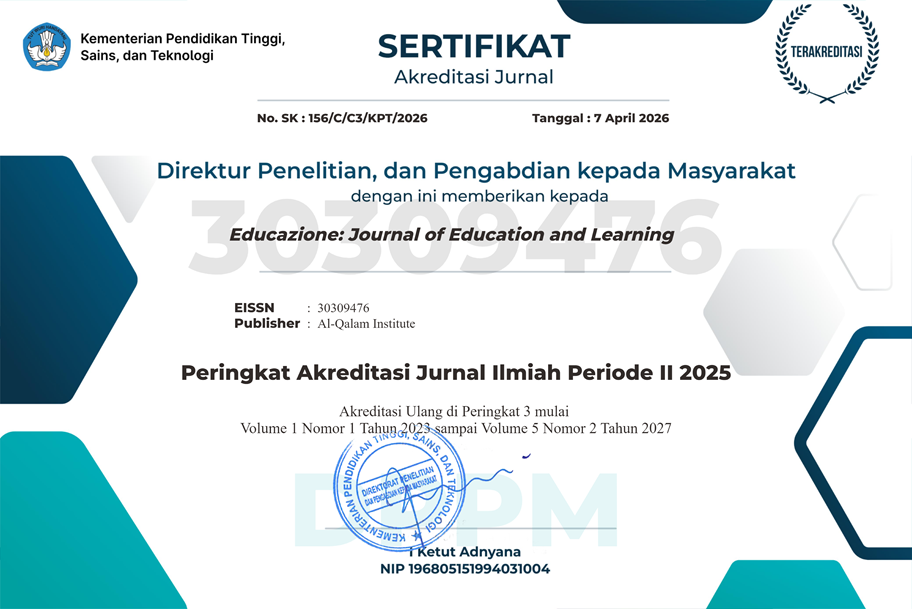 Lihat penuh
SINTA 3
Publication Ethics
Educazione: Journal of Education and Learning is a peer-reviewed international journal. This statement clarifies the ethical behaviour of all parties involved in the act of publishing an article in this journal — the author, the chief editor, the Editorial Board, the peer reviewer, and the publisher Al-Qalam Institute — as well as allegations of research misconduct. It is based on COPE’s Best Practice Guidelines for Journal Editors.
The publication of an article in a peer-reviewed journal is an essential building block in the development of a coherent and respected network of knowledge. It directly reflects the quality of the authors’ work and the institutions that support them. It is therefore important to agree upon standards of expected ethical behaviour for all parties: the author, the journal editor, the peer reviewer, the publisher, and the society.
Al-Qalam Institute, as the publisher, takes its duties of guardianship over all stages of publishing extremely seriously and recognizes its ethical and other responsibilities. We are committed to ensuring that advertising, reprint, or other commercial revenue has no impact or influence on editorial decisions. The Institute and Editorial Board will also assist in communications with other journals and/or publishers where useful and necessary.
Research misconduct means fabrication, falsification, citation manipulation, or plagiarism in producing, performing, or reviewing research and writing an article, or in reporting research results. When authors are found to have been involved with research misconduct, Editors have a responsibility to ensure the accuracy and integrity of the scientific record.
In cases of suspected misconduct, the Editors and Editorial Board use the best practices of COPE to resolve the complaint and address the misconduct fairly, including an investigation of the allegation. A submitted manuscript found to contain such misconduct will be rejected; for a published paper, a retraction can be issued and linked to the original article.
The first step determines the validity of the allegation, whether it is consistent with the definition of research misconduct, and whether those alleging misconduct have relevant conflicts of interest. If misconduct or other substantial irregularities are possible, the allegations are shared with the corresponding author, who — on behalf of all coauthors — is requested to provide a detailed response. Additional review and expert involvement (such as statistical reviewers) may follow. For cases where misconduct is unlikely, clarifications or additional analyses published as letters to the editor, often with a correction notice, are sufficient.
Institutions are expected to conduct an appropriate and thorough investigation. Ultimately, authors, journals, and institutions share the obligation to ensure the accuracy of the scientific record. By responding appropriately — through corrections, retractions with replacement, and retractions — the journal continues to fulfill its responsibility for the validity and integrity of the scientific record.
The editor is responsible for deciding which submitted articles should be published. The validation of the work and its importance to researchers and readers must always drive such decisions. Editors may be guided by the policies of the editorial board and constrained by legal requirements regarding libel, copyright infringement, and plagiarism, and may confer with other editors or reviewers.
The journal has a clear procedure for handling complaints against the journal, Editorial Staff, Editorial Board, or Publisher. The scope includes any part of the journal’s business process — editorial process, citation manipulation, unfair editor/reviewer, peer-review manipulation, etc. Cases are processed according to COPE guidelines and should be sent by email to: wahidunsatoe@gmail.com
An editor evaluates manuscripts for their intellectual content without regard to race, gender, sexual orientation, religious belief, ethnic origin, citizenship, or political philosophy of the authors. Editorial staff must not disclose information about a submitted manuscript to anyone other than the corresponding author, reviewers, potential reviewers, other editorial advisers, and the publisher. Unpublished materials disclosed in a submitted manuscript must not be used in an editor’s own research without the express written consent of the author.
If research involves chemicals, humans, animals, procedures, or equipment with unusual hazards, authors must clearly identify these to obey ethical conduct standards, and provide legal ethical clearance where required. If research involves confidential or business/marketing data, authors should clearly justify whether the data will be securely hidden.
The journal accepts discussion and corrections on published articles from readers. A reader may contact the Editor-in-Chief by email explaining the discussion or correction. If accepted, it will be published in the next issue as a Letter to Editor. Authors may reply through the Editor-in-Chief, and the reply may be published as a Reply to Letter to Editor.
Lihat penuh