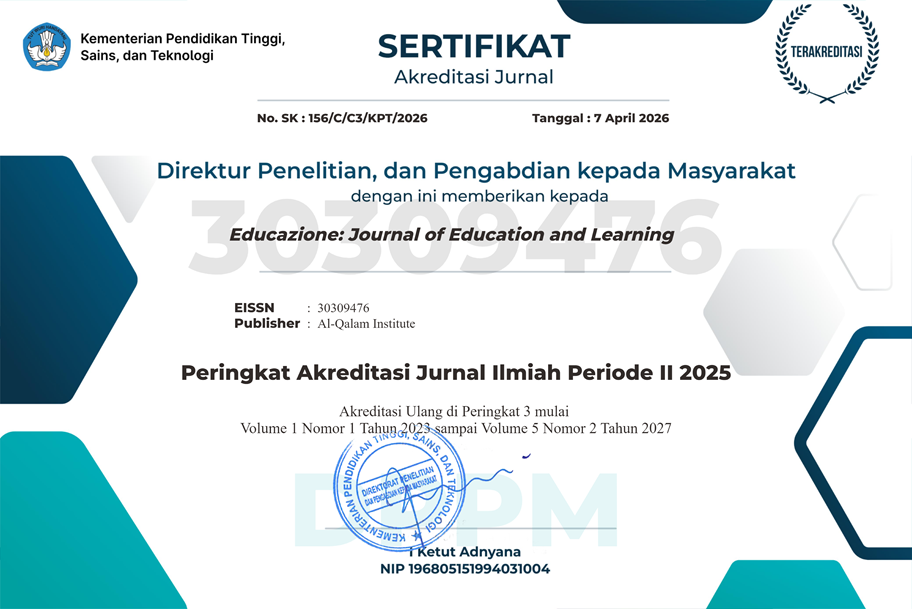
Implementation of Hybrid Learning and PAI Teachers' Communication Methods in Improving Students' Motivation and Learning Achievement
DOI:
https://doi.org/10.61987/educazione.v3i1.2519Keywords:
Hybrid Learning, Teacher Communication, Student MotivationAbstract
This study aims to analyze the implementation of hybrid learning and the communication strategies employed by Islamic Religious Education (PAI) teachers to enhance student motivation and learning achievement. Utilizing a qualitative descriptive approach with a case study design, this research was conducted at SMP Patriot Kota Bekasi. Data were collected through participatory observation, in-depth interviews, and documentation involving 37 informants, including school administrators, the PAI teacher, students, and parents. The findings reveal that implementing hybrid learning, specifically through Flipped Classroom and Blended Learning models, effectively mitigates student boredom and restores enthusiasm compared to prolonged full online instruction. Furthermore, the PAI teacher’s strategic communication—such as establishing a dedicated WhatsApp group for pre-class motivation, providing personalized attention, offering consistent appreciation, and fostering an interactive learning atmosphere—serves as a critical catalyst in rebuilding students' intrinsic drive. Consequently, these combined strategies significantly contribute to the improvement of students' character, motivation, and overall academic achievement in PAI subjects during the post-pandemic educational transition.
References
Al-Hashmi, S. (2021). A Study on the Impact of the Sudden Change to Online Education on the Motivation of Higher Education Students. Higher Education Studies, 11(3), 78–88. https://doi.org/10.5539/hes.v11n3p78
Amin, A., Alimni, A., Kurniawan, D. A., Triani, E., & Pratama, W. A. (2022). Implications of Teacher Interpersonal Communication Ability on Student Learning Motivation in Islamic Religious Education Lessons During Pandemic. Journal of Education Research and Evaluation, 6(1), 156–167. https://doi.org/10.23887/JERE.V6I1.39547
Anggraini, E. S. (2021). Pola Komunikasi Guru Dalam Pembelajaran Anak Usia Dini Melalui Bermain. Bunga Rampai Usia Emas, 7(1).
Fauzi, I., Hermawan, I., & Khusuma, S. (2020). Teachers’ Elementary School in Online Learning of COVID-19 Pandemic Conditions. Jurnal Iqra’ : Kajian Ilmu Pendidikan, 5(1), 58–70. https://doi.org/10.25217/JI.V5I1.914
Hodges, C., Moore, S., Lockee, B., Trust, T., & Bond, A. (2020). The Difference Between Emergency Remote Teaching and Online Learning. https://www.scirp.org/reference/referencespapers?referenceid=2775840
Janke, S., Messerer, L. A. S., & Daumiller, M. (2022). Motivational Development in Times of Campus Closure: Longitudinal Trends in Undergraduate Students’ Need Satisfaction and Intrinsic Learning Motivation. British Journal of Educational Psychology, 92(4), 1582–1596. https://doi.org/10.1111/BJEP.12522
Jiménez-Valverde, G., Fabre-Mitjans, N., & Guimerà-Ballesta, G. (2025). Narrative-Driven Digital Gamification for Motivation and Presence: Preservice Teachers’ Experiences in a Science Education Course. Computers, 14(9), 384. https://doi.org/10.3390/COMPUTERS14090384
Kharismatunisa, I. (2023). Innovation and Creativity of Islamic Religious Education Teachers in Utilizing Digital-Based Learning Media. Scaffolding: Jurnal Pendidikan Islam dan Multikulturalisme, 5(3), 519–538. https://doi.org/10.37680/SCAFFOLDING.V5I3.3700
Kikuchi, K. (2025). Restructuring Physical Therapy Education After COVID-19: A Narrative Review on the Global Perspectives and the Emerging Role of Hybrid Learning Models. Cureus, 17(7), e88034. https://doi.org/10.7759/CUREUS.88034
Knaut, A. E., Thaler, H., Maran, T., Kraus, S., & Narduzzo, A. (2024). Navigating the New Normal: Exploring the Evolution of Entrepreneurship Education in the Aftermath of COVID-19. The International Journal of Management Education, 22(3), 101067. https://doi.org/10.1016/J.IJME.2024.101067
Kong, W., Li, D., & Guo, Q. (2024). Research on Flipped Classrooms in Foreign Language Teaching in Chinese Higher Education. Humanities and Social Sciences Communications, 11(1), 525. https://doi.org/10.1057/s41599-024-03019-z
Laili, S. R., Hasanah, K. U., & Roifah, N. I. (2022). Development of Islamic Religious Education Teacher Competency and Character Through Blended Learning. Nazhruna: Jurnal Pendidikan Islam, 5(2), 864–875. https://doi.org/10.31538/NZH.V5I2.2359
Lukita, D., & Sudibjo, N. (2021). Faktor-Faktor yang Mempengaruhi Motivasi Belajar Siswa di Era Pandemi COVID-19. Akademika | Jurnal Teknologi Pendidikan, 10(1).
Nasihin, N., Khoirun, F., Aminudin, A., & Mastur, A. A. (2025). The Role of Learning Motivation and Social Interaction in Enhancing Students’ Speaking Skills: Managerial Perspectives in Educational Management. Journal of Educational Management Research, 4(3), 1324–1335. https://doi.org/10.61987/JEMR.V4I3.1042
Nasrah, & Muafia, A. (2020). Analisis Motivasi Belajar dan Hasil Belajar Daring Mahasiswa Pada Masa Pandemik Covid-19. Jurnal Riset Pendidikan Dasar, 03(2).
Ningrum, D. M., Aprilia, T. H., & Maduarawee, M. (2025). PAI Teacher’s Strategy in Improving Student Achievement at MAN PK MAN 4 Jombang. International Journal of Religion and Social Community, 3(1), 55–68. https://doi.org/10.30762/IJORESCO.V3I1.3589
Dewi, F. P. A., & Zulfa, N. F. (2025). Analysis of Challenges and Opportunities of Online Learning for Islamic Religious Education Teachers. JISEI: Journal of Islamic Studies and Educational Innovation, 1(3), 322–333. https://doi.org/10.61094/jisei.v1i3.63
Rejeki, N. (2022). Analisis Learning Loss dan Strategi Recovery Pasca Pembelajaran Jarak Jauh. Nusantara: Jurnal Pendidikan Indonesia, 2(3), 407–422. https://doi.org/10.14421/NJPI.2022.V2I3-2
Ribeiro, L. M., Cunha, R. S., Andrade E Silva, M. C., Carvalho, M., & Vital, M. L. (2021). Parental Involvement During Pandemic Times: Challenges and Opportunities. Education Sciences, 11(6), 302. https://doi.org/10.3390/EDUCSCI11060302
Staneviciene, E., & Žekienė, G. (2025). The Use of Multimedia in the Teaching and Learning Process of Higher Education: A Systematic Review. Sustainability, 17(19), 8859. https://doi.org/10.3390/SU17198859/S1
Stevanović, A., Božić, R., & Radović, S. (2021). Higher Education Students’ Experiences and Opinion About Distance Learning During the Covid-19 Pandemic. Journal of Computer Assisted Learning, 37(6), 1682–1693. https://doi.org/10.1111/JCAL.12613
Sulthoniyah, I., NurAfianah, V., Rizkiatul Afifah, K., Lailiyah, S., Magister Guru Madrasah Ibtidaiyah, P., & UIN Sunan Ampel Surabaya, P. (2022). Efektivitas Model Hybrid Learning dan Blended Learning Terhadap Motivasi Belajar Siswa Sekolah Dasar. Jurnal Basicedu, 6(2), 2466–2476. https://doi.org/10.31004/BASICEDU.V6I2.2379
Suryaningsih, S. S., Pd, M. K., & Belhassen, Y. (2024). Blended Learning Models in the Post-Pandemic Era: Redefining Classroom Instruction and Online Learning Integration. Scientechno: Journal of Science and Technology, 3(3), 294–304. https://doi.org/10.70177/SCIENTECHNO.V3I3.1743
Tisnia, T. (2022). Implementasi Kompetensi Sosial Guru Dalam Meningkatkan Motivasi Ekstrinsik Siswa Pada Mata Pelajaran PAI. Jurnal Educatio, 8(1).
Vaz, C., Sousa, J., Bastardo, R., Peres, E., & Reis, M. J. C. S. (2026). From Resistance to Resilience: Organizational Learning and Digital Transformation in Higher Education Under Crisis. Education Sciences, 16(5), 735. https://doi.org/10.3390/EDUCSCI16050735
Yang, Y., Liu, K., Li, M., & Li, S. (2022). Students’ Affective Engagement, Parental Involvement, and Teacher Support in Emergency Remote Teaching During the COVID-19 Pandemic: Evidence From a Cross-Sectional Survey in China. Journal of Research on Technology in Education, 54(S1), S148–S164. https://doi.org/10.1080/15391523.2021.1922104
Downloads
Published
How to Cite
Issue
Section
License
Copyright (c) 2025 Kholik, Fajar Syarif

This work is licensed under a Creative Commons Attribution-NonCommercial-ShareAlike 4.0 International License.